
I wrote in my last piece about coming back to oiling my scalp. What I did not say is what brought me back.
I was seventeen and dealing with two things at once.
The first was my scalp, which had started flaking after I abandoned the oiling ritual I grew up with. The second was my forehead, which had broken out in small bumps along my hairline. Whether the two were connected, I had no idea.
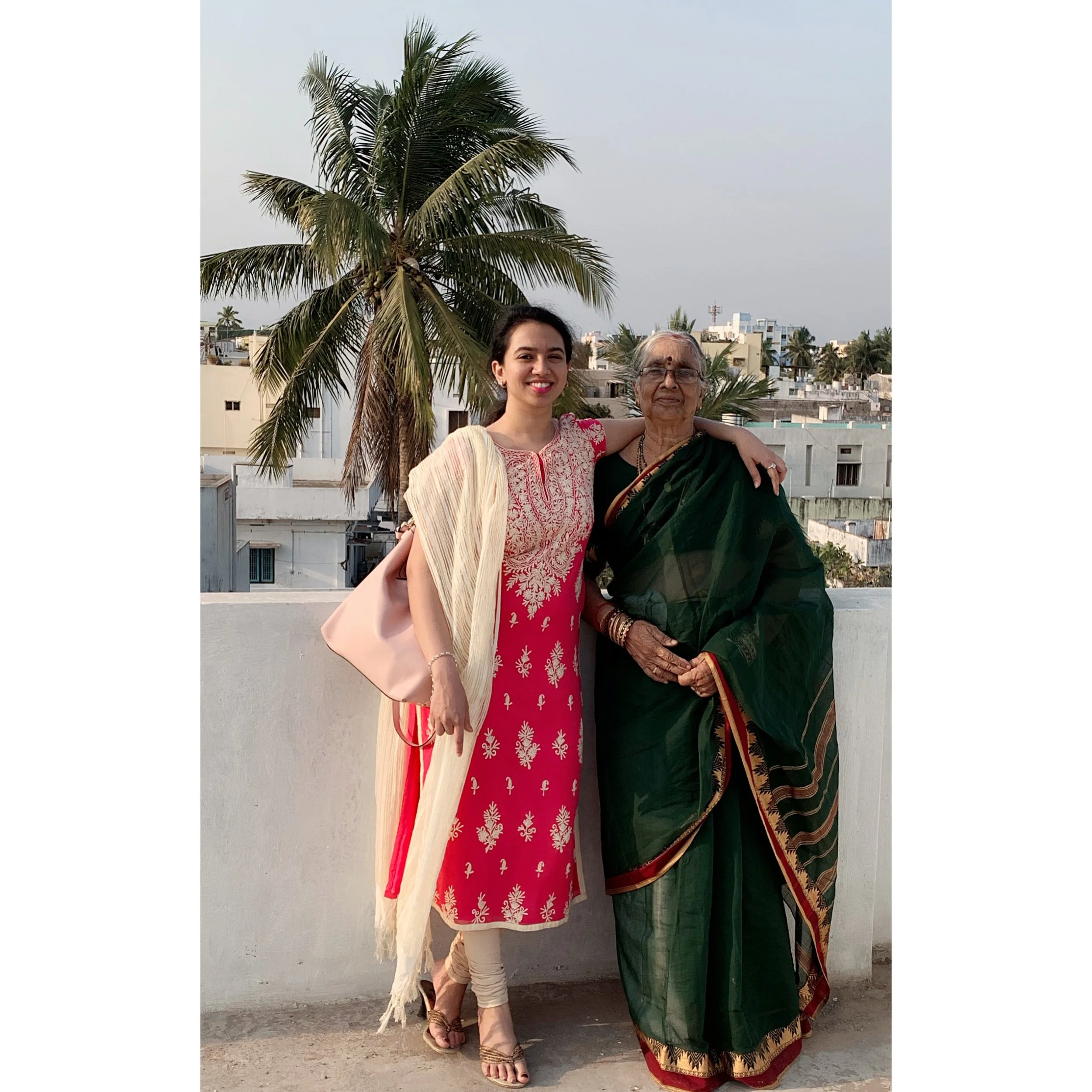
My grandmother told me to try neem.
Not the neem oil you buy in a dark glass bottle, the concentrated kind pressed from the seed that smells like something you would use on a crop. She meant the neem infused coconut oil my mother made in her kitchen. Neem steeped into warm coconut oil, strained, poured into whatever jar was clean. It is a gentler thing entirely. Most of what is in the jar is coconut oil, and the neem is in there as a guest rather than the host.
She said to use it on my scalp, and separately she suggested neem for my skin.
I never got round to the second part. I started oiling my scalp with it overnight before wash day, the way I had been taught as a child, and within weeks both things had settled. The flaking eased. So did my forehead, which I had not treated with anything at all.
I want to be careful here, because this is the point where a blog post usually overreaches.

I do not know what happened. I was never examined by a dermatologist, I have no before and after beyond my own memory, and one person's experience over one season proves nothing about anybody else's scalp. A hundred other things were changing in my life at seventeen. I am telling you what I noticed, not what I can prove.
What I can tell you is what the science says, which is more interesting than I expected.
The yeast most strongly implicated in dandruff, Malassezia, also causes a condition called Malassezia folliculitis. It produces small, uniform bumps that appear most often on the forehead and along the hairline, where the yeast is most concentrated because of its proximity to the scalp. It looks so much like acne that it is routinely mistaken for it. In one review, 65 per cent of patients with Malassezia folliculitis had previously been treated for ordinary acne. People with dandruff are at higher risk of it.
So there is a documented reason why a scalp and a forehead might belong to the same story. Whether mine did, I cannot say.
The evidence on neem: Promising, incomplete.
On neem itself, the evidence is real but uneven. A 2025 study in Cureus applied neem leaf paste to the scalps of 50 young women three times a week for two weeks. By the end, 44 per cent had no dandruff at all, against 4 per cent in the control group. A 2024 study in Scientific Reports found a neem and rosemary extract performed comparably to ketoconazole against Malassezia in laboratory conditions. And a 2025 paper in Pharmaceuticals found that gedunin, a compound in neem, reduced acne related skin inflammation in a mouse model.
Neem seed oil is also roughly half oleic acid, with palmitic, stearic and linoleic acid alongside it, which is a profile that supports the skin barrier rather than stripping it. The compounds that give neem its antifungal reputation, azadirachtin and nimbin among them, sit in the same oil.
Across every community with textured hair there are ingredients like this one. Passed down, widely used, quietly effective in the experience of the people using them, and almost entirely unstudied. The observations exist. The generations of informal evidence exist. What does not exist is the research funding to find out whether the observations hold up, at what concentration, in what preparation, and for whom.
At sparrow we want to collect these stories and name their star ingredients, loudly enough that the scientific community and the industries funding it start paying attention. Not to replace the knowledge with a study. To give it one, so that what finally reaches a shelf is something that works and is safe to use.
My grandmother was right, in my case. I would like someone to find out whether she was right in general.